
Medical Billing Trends in 2024
AI, ChatGPT and Google Bard, these were words unheard of before 2023. Now, they are commonplace. Such tremendous power of influence that AI has is sure to leave some marks on almost every industry. There’s already research springing up to apply AI in medical billing. 2023 ends but the implementation of Artificial Intelligence, first introduced to humanity (except geeks) by ChatGPT, is here to stay. What should we expect the major trends and future of medical billing to be in the year 2024?
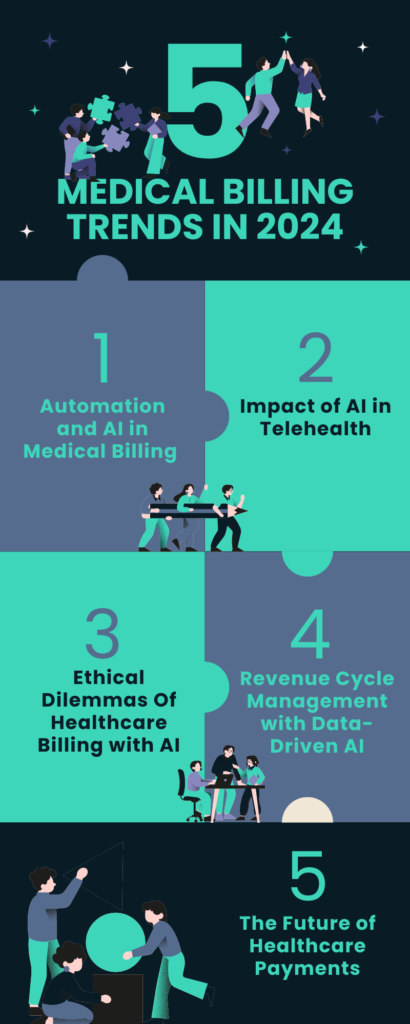
5 Trends to Follow if You want to Understand the Future of Medical Billing
Well, we went ahead to look into key indicators. These indicators mark how this “AI thing” is going to unfold in 2024, in healthcare finances. We are back after having discovered five key trends. These are the topics set to shape the medical billing industry in 2024. Online Searched Terms were used as a starting point of our Dataset.
- Rise of automation in medical billing
- Changing operations in telehealth industry
- AI and Healthcare regulations
- Data-driven revenue cycle management
- Innovations in healthcare payments
Each of these trends has significant implications for healthcare professionals, patients, and the industry as a whole. Down below, we will break them down into understandable chunks that you can consume. Use this information to make better, smarter decisions!
Automation and AI in Medical Billing
Social Media Discussions
AI is brewing quite a stir on social media. Twitter has a lot of people expressing anxieties over job securities. They are however met with people conducting optimistic discussions about AI’s potential to streamline the medical billing process. LinkedIn is overflowing with articles touting the benefits of AI, promising increased accuracy and efficiency. But the true battleground (at least for the patient sides of the discussion) lies within Facebook Groups. Patients, armed with questions and concerns seek answers on how AI will impact their medical bills and privacy. The lines between excitement and apprehension blur as both the healthcare professionals and patients struggle to write the future of AI in medical billing, together.
Healthcare professionals were generally praising AI’s ability to automate repetitive and tedious tasks. They envision a future where AI handles coding and claim submissions with superhuman accuracy (we’re talking of having 0 mistakes whatsoever), leaving more time for healthcare professionals to deliver quality care. Their optimism is palpable.
Concerns for Future of Medical Billing on Social Platforms
Amidst the cheers are some voicing concerns. Some healthcare professionals are also expressing fears about job displacement. They worry that AI will render their skills obsolete, leaving them to navigate an uncertain future. Their tweets paint the cliché picture of a future with robots replacing human jobs.
The patients are primarily seeking the comfort that comes with clarity. They are concerned about the impact of AI on their medical bills, wondering if these automated systems will result in higher costs. Some patients are also worried about the security of their personal data, unsure of how AI will handle their sensitive information. These questions hang in the air, at least for now as we enter 2024.
In these uncertain times, one thing remains clear: AI in medical billing is a double-edged sword. It holds the promise of efficiency and accuracy, but also carries the risk of job displacement and ethical (security) concerns. Whether we embrace this technology with open arms or approach it with caution, the thing I am confident about is that the future of medical billing is being written right now. Each tweet, post, and comment is shaping its trajectory. The outcome remains to be seen, but the lines have been drawn, and the future of medical billing hangs in the balance.
Online Search Trends Shaping the Future of Medical Billing:
Google Trends highlight a surge in searches for “AI in healthcare” and “automation in medical billing”. Quora is filled to the brim with questions surrounding the ethical implications of AI in healthcare and its potential impact on patient care. As automation becomes more commonplace, we have to make and maintain the delicate balance between technological advancements and the human touch in healthcare.
Impact of AI in Telehealth
The rapid adoption of telehealth has revolutionized healthcare delivery, but its integration with existing billing systems has presented challenges as well. Inconsistent coding practices, complex insurance rules, and administrative burden hinder both providers and patients. Automations and AI in telehealth billing industry do offer some promising solutions. These could range from automating mundane tasks, streamlining existing workflows, and enhancing the overall telehealth billing experience.
Top Applications of AI in Telehealth Billing:
- Automated Coding and Claim Submission: Algorithms can analyze medical records and automatically assign appropriate codes, eliminating manual coding errors and speeding up claim submission. This reduces administrative burden and improves accuracy, leading to faster reimbursements for providers. 2024 could be the year we see this process come to life.
- Real-time Insurance Eligibility Verification: AI can instantly verify patient insurance coverage for specific telehealth services. This will help in preventing claim denials and upfront patient awareness of potential costs. This transparency builds trust and reduces financial surprises for patients later in their healthcare process.
- Fraud Detection and Prevention: Large Datasets can be used to train an AI that can go on to analyze billing patterns. This will help it identify anomalies and potential fraudulent claims. This protects healthcare systems from financial losses and ensures accurate reimbursement for legitimate services.
- Patient Communication and Billing Transparency: We could possibly meet AI-powered chatbots and virtual assistants in 2024. They will be able to answer patient billing questions, explain bills in clear language, and offer payment options. This will significantly improve patient satisfaction and reduces administrative calls for providers.
- Data Analytics and Process Optimization: AI can analyze vast amounts of billing data to identify trends, optimize coding practices, and streamline workflows. This data-driven approach will necessarily lead to cost reductions and improved efficiency.
Challenges of AI Implementation in Telehealth Industry
Following are the top 3 most expressed concerns by our studied audience with regards to the implementation of AI in Telehealth Billing Industry:
- Data Privacy and Security: Healthcare data breaches impacted over 39M individuals in 2023 alone. People want it to be absolutely certain that their data privacy and security is paramount when implementing AI in healthcare. Robust security measures and ethical data-governance practices are essential if AI is to be implemented to make telehealth a sustainable long-term industry.
- Human Oversight and Transparency: While AI can automate tasks, human oversight and control remain crucial. Clear protocols and transparent decision-making processes are necessary to ensure trust and accountability. Anything amiss in any machine is bound to be repeated and we must be vigilant when working with any forms of intelligence, even if its Artificial per se.
- Integration with Existing Systems: Even though the technology is huge, don’t expect the industry to go all nuts when integrating AI with existing billing systems. Careful planning and phased implementation are necessary to avoid disruption and ensure successful adoption of this new tool.
Ethical Dilemmas in the Future of Medical Billing
The integration of Artificial Intelligence (AI) into healthcare holds immense potential. However, this journey is not without its challenges either and particularly at a time when healthcare regulations are complex as ever! Given below are the most prominent concerns expressed on the internet from people all across the globe, as well as perspectives of various stakeholders.
Healthcare Regulations and Compliance
Industry professionals in healthcare have to spend time to understand and follow regulatory laws. These regulations are being made to counter negative implications of AI now. Twitter often serves as a platform for their frustrations. They voice concerns regarding compliance burdens and increasing complexity are readily expressed in moments of break and a breath. LinkedIn, however, offers a counterpoint. Compliance experts on LinkedIn sharing valuable insights and resources, acting as guides through the new regulatory “maze”!
Patient Confusions
The sub-surface emotional impact of these challenges is particularly evident within Facebook. Patients, vulnerable and often anxious, seek reassurance and guidance regarding their rights and data privacy. Google Trends reflect a picture of this anxiety, with “HIPAA compliance” and “healthcare regulations” trending high. In this age of information, people appear to be looking for a way to control what others access.
Transparency in the Future of Medical Billing
Building trust is perhaps the best thing to do as a start, to successfully integrate AI into healthcare systems. AI has to shed its opacity, openly revealing its decision-making processes, biases, and limitations. Patients deserve to be informed partners, not simply data points in an algorithm. Human-centered AI, not a robotic replacement, must be the guiding principle here. This will result in fostering collaboration and trust between humans and machines.
The future of AI in healthcare isn’t a dystopian vision of robotic overlords (as is often imagined). Rather it is more of a scenario where AI empowers patients, safeguards data, and augments human expertise. This future requires a commitment to ethical responsibility. The ethical challenges of AI in healthcare are not insurmountable. By fostering open dialogue, we can embrace continuous learning and prioritize ethical principles. This will help us navigate this complex landscape and unlock the true potential of AI for the betterment of healthcare.
Role of Data-Driven AI in the Future of Medical Billing
Data-driven decision-making (DDDM) in healthcare billing is the strategic leveraging of healthcare data to optimize billing processes. This ends up improving revenue collection and ultimately enhance patient care. This approach moves beyond traditional, reactive methods and utilizes data analysis and predictive models to inform proactive and evidence-based decisions.
Benefits of DDDM in healthcare billing:
- Data analysis can identify billing errors, claim denials, and undercoding, leading to higher reimbursements and reduced financial losses.
- Automating tasks like coding and claim submission frees up staff for more complex tasks and reduces human error.
- DDDM can predict patient financial obligations and offer flexible payment options, improving patient satisfaction and loyalty.
- Data analysis can identify trends and patterns to predict future billing issues, allowing proactive solutions to be implemented.
How AI can assist in DDDM:
- Natural Language Processing (NLP): Can analyze medical records and documents to extract relevant information for accurate coding and claim submission.
- Machine learning (ML): Can identify patterns and trends in billing data to predict claim denials, fraud, and undercoding.
- Robotic Process Automation (RPA): Can automate repetitive tasks like data entry, claim submission, and follow-up, improving efficiency and accuracy.
- Chatbots and virtual assistants: Can answer patient billing questions, provide payment options, and offer personalized support, improving patient experience.
Example:
Suppose a hospital implements an AI-powered system that analyzes patient demographics, insurance coverage, and treatment history. The system identifies a group of patients with a high risk of claim denials for a specific procedure. The hospital proactively reaches out to these patients to clarify their insurance coverage and offer alternative payment options, significantly reducing denials and improving revenue collection.
Healthcare Payments in the Future of Medical Billing
The continuously evolving landscape of healthcare payments in 2024 can already be predicted by the interests of the industry giants. Three key forces – AI, data, and consumerism – seem to be leading the industry, offering a glimpse of a future brimming with potential, but unequivocally shadowed by uncertainties nonetheless!
The “AI” factor in Efficiency
We are moving towards a world where medical bills will vanish (perhaps not in 2024 but eventually so), replaced by seamless, personalized payment journeys for each patients. At the backend of these journeys, AI will be working as “fuel”, keeping it all running. It will automate tedious tasks, freeing up human staff to focus on complex patient interactions. AI-powered bots will guide patients through payment options, offering tailored plans based on their financial needs and preferences. AI’s potential goes beyond administrative assistance. Its analytical prowess can identify fraudulent claims in real-time, safeguarding healthcare systems from financial compliant issues. Predictive models will anticipate potential payment issues, enabling proactive interventions and improved revenue cycle management with AI.
Importance of Data in the Future of Medical Billing
Data is and most likely will remain the fuel propelling healthcare payments forward in 2024. Advanced analytics introduced by industry leaders will potentially extract hidden patterns and trends from vast medical and financial datasets, making data-driven decisions that optimize revenue cycle management with AI. Healthcare organizations will leverage this knowledge to predict patient behavior, personalize communication, and tailor payment options to individual needs. Data will also play a crucial role in measuring the effectiveness of value-based care models. These models are a growing trend in healthcare reimbursement. By analyzing patient outcomes and resource utilization, healthcare providers can demonstrate the value they deliver and secure fair compensation.
Is the Future of Medical Billing Patient-Centric?
With AI now, Patients would no longer be just the passive recipients of care. They will be empowered in the 2024 healthcare payment industry. They will get more transparency in billing practices, access to cost estimates for their procedures, and a choice of flexible payment options. Blockchain technology could possibly pave the way for secure and portable healthcare wallets. This will give patients control over their financial information and enabling seamless transactions across different providers.
The future of medical billing is going to have subscription models, telemedicine payments, and point-of-care financing. Thus, we will be effectively catering to diverse patient needs and reducing financial barriers to access healthcare. This shift towards consumerism demands healthcare organizations to prioritize patient experience such as offering convenient and accessible payment options.
Where do you see the future of medical billing in 2024?
The future of healthcare billing in 2024 is being written by us, me and you, today. We collectively stand at a crossroads, where the promise of AI-driven innovation meets challenges of ethical dilemmas and technological uncertainties. The integration of AI must prioritize human oversight. This will ensure that AI technology remains a tool to empower, not replace, healthcare professionals.
To successfully complete this transition in 2024, a multi-stakeholder approach is crucial. Healthcare providers, technologists, policymakers, and patients must engage in open dialogue. Sharing best practices and co-creating solutions that prioritize ethical considerations and patient well-being are the way forward. Only then can we unlock the true potential of AI in healthcare billing. This could pave the way for a future where efficient, accessible, and patient-centered healthcare financials support the delivery of high-quality care for all.